
CfP. Defusing Violence
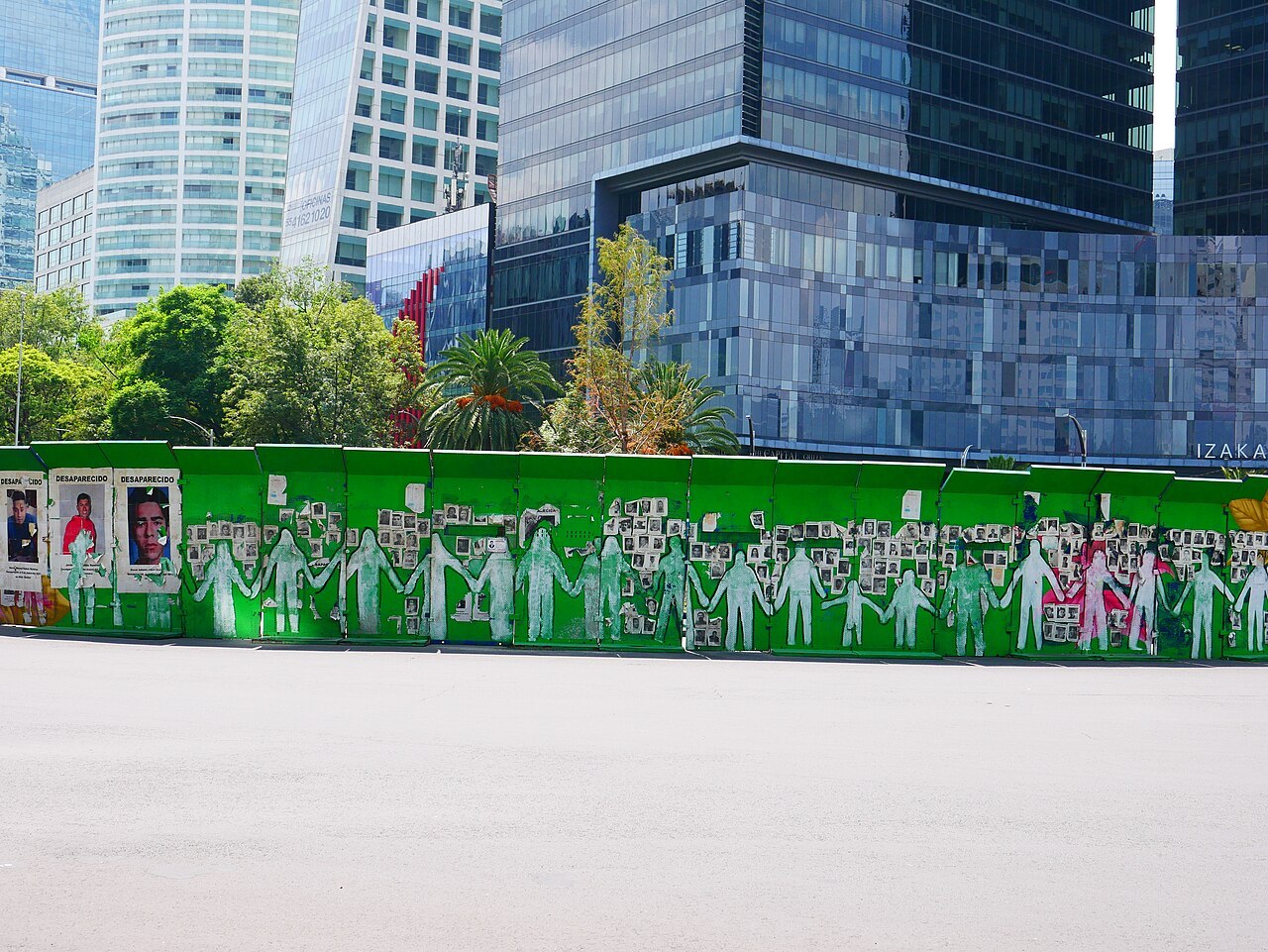
Glorieta de las y los desaparecidos. Photograph by Luis Alvaz. Public domain.
This special issue of The February Journal, edited by Fabiola de Lachica Huerta (Metropolitan Autonomous University, Mexico City) and Bianca Ramírez Rivera (University of Groningen, Groningen; The February Journal, Berlin), and to be published in October 2027, will be dedicated to practices of defusing violence.

On April 30, 2023, relatives of disappeared persons gathered with their children at the Glorieta de las y los Desaparecidos ('Roundabout of the Disappeared') in Guadalajara, Jalisco. The site, a public space in the state's capital, has been appropriated by families as a place of collective remembrance and a means of drawing attention to the disappearance crisis in a state with one of the highest rates of such crimes in Mexico. Colectivo Luz de Esperanza, an organization that coordinates search efforts for missing persons across Jalisco, convened the event to commemorate International Children’s Day (Torres, 2023). Surrounded by posters and banners displaying the photographs and search records of the disappeared, the children and adolescents whose relatives participate in the collective received footballs, bicycles, and other toys. Set against a broader humanitarian crisis in Mexico (CIDH, 2026), the gathering allowed families to share a meal, pause their search activities, and reinforce communal ties. Such moments do not diminish the grief and violence these families endure; rather, they offer a temporary reprieve. Although violence remains omnipresent in their surroundings, the families deliberately sought to defuse its weight, however briefly. In this context, 'defusing violence' can be understood as a set of practices through which communities release tension, generate solidarity, share moments of joy, and develop creative strategies for safeguarding one another.
Many of the events that currently provoke global outrage involve violence perpetrated by state and non-state actors, including Russia’s full-scale invasion of Ukraine, the October 7, 2023 attacks in southern Israel, the genocide in Gaza, the rise of far-right xenophobia and racism in the United Kingdom, the detention of migrants by U.S. Immigration and Customs Enforcement (ICE), and the repression of movements opposing right-wing governments in Latin America (Bolcatto & Souroujon, 2020). Other forms of violence, though different in scale and origin, similarly unsettle societies and disrupt everyday life, such as school shootings (Schildkraut et al., 2018), the discovery of mass graves in Mexico (Lorusso, 2021), and hate crimes targeting gender and sexual minorities worldwide (Bjørgo, 2003). Narratives and images of this violence persist across physical and digital spaces and circulate widely, turning distressing images, graphic videos, and threatening statements into viral content (Juhasz, 2021).
Social position and identity-based categories shape differential exposure to risk, leaving certain individuals and groups more vulnerable to harm than others. Nevertheless, spaces exist in which those exposed to such risks can experience a sense of safety, as when families of the disappeared gather to share moments of celebration with their children. Feeling safe, however, is not equivalent to being free from risk. Rather, it may entail being cared for (Larsson et al., 2023), sustaining protective social ties, or avoiding perceived danger (Zuberi, 2018).
These spaces of safety are constituted not only by their physical location but also by the social relationships and practices that convey protection or comfort within them (Stark et al., 2021). 'Safety' or 'being safe' is less an inherent property of a place than an outcome of what people do together there. Schools, sports facilities, cultural venues, and other communal settings exemplify sites where participants can cultivate relationships of care, organize collective activities, and come together to share their time. Through repeated interaction, these environments can foster trust, mutual recognition, and a sense of belonging, which may in turn buffer participants against the risks they face elsewhere. Understood in this way, the protective capacity of a space depends on the people who inhabit it and the practices through which they sustain it.
Conversely, where care and protection are absent, either by the action or omission of the state or other violent agents, those who seek to defuse the violence perpetrated on them often work to create those spaces into contested terrain between protection and violence. Student strikes, sit-ins, and other mobilizations illustrate this dynamic: confronted with multiple forms of violence, collectives demand a response from the authorities while developing their own peer-to-peer protection strategies. Latin American examples include student strikes against gender-based violence in universities (Cerva Cerna, 2020; Rovira-Sancho & Morales-i-Gras, 2022), the demonstrations in Mexico City during the 2026 World Cup to draw attention to the disappearance crisis, and the ollas populares (community soup kitchens) in some of Argentina’s poorest neighborhoods (Gieco et al., 2014). In each case, mobilization operates as a form of 'defusing violence,' releasing tension while building the care on which safety depends.
We aim to shed light on the actions and practices of defusing violence that, as several of the cases above illustrate, do not seek to resolve the violence in which they are embedded but instead offer release, protection, and safety to those at risk. We invite contributions that document how communities build knowledge about coping with violence in everyday life, compile experiences from regions exposed to different forms of violence, and capture these experiences in formats suited to the spaces where they emerge. In our own work with student communities after a strike at a public university, for example, we produced a fanzine documenting the strategies that women developed and shared to stay safe.
We invite research-based contributions relating to forms and mechanisms of defusing violence. We encourage academics, artists, activists, community promoters, and anyone else compelled to share how they defuse violence in their settings, and how violence, rather than a buffer, can be a catalyst for creative ways to keep us safe. We welcome academic articles, visual or reflective essays, and artistic collaborations of various genres that our journal can accommodate.
Bibliography
Bjørgo, T. (2003). Violence against ethnic and religious minorities. In W. Heitmeyer & J. Hagan (Eds.), International handbook of violence research (pp. 785–799). Springer. https://doi.org/10.1007/978-0-306-48039-3_39
Bolcatto, A., & Souroujon, G. (Eds.). (2020). Los nuevos rostros de la derecha en América Latina: Desafíos conceptuales y estudios de caso [The new faces of the right in Latin America: Conceptual challenges and case studies]. Ediciones UNL.
Cerva Cerna, D. (2020). Activismo feminista en las universidades mexicanas: La impronta política de las colectivas de estudiantes ante la violencia contra las mujeres [Feminist activism in Mexican universities: The political imprint of student collectives in response to violence against women]. Revista de la Educación Superior, 49(194), 137–157.
Comisión Interamericana de Derechos Humanos. (2026). Informe sobre desapariciones en México [Report on disappearances in Mexico].
Gieco, M., Eandi, M., Iavicoli, T., & Butinof, M. (2014). Significaciones de los modos de organización y las preparaciones culinarias en torno a la vulneración del derecho a la alimentación [Meanings of forms of organization and culinary preparations in relation to the violation of the right to food]. Diaeta, 32(146), 27–34.
Juhasz, A. (2021). Virality is virility: Viral media, popularity, and violence. Indiana University Press.
Lorusso, F. (2021). Una discusión sobre el concepto de fosa clandestina y el contexto mexicano: El caso de Guanajuato [A discussion of the concept of the clandestine grave and the Mexican context: The case of Guanajuato]. Historia y Grafía, (56), 129–170. https://doi.org/10.48102/hyg.vi56.354
Rovira-Sancho, G., & Morales-i-Gras, J. (2023). Idus de marzo en México: La acción directa en las redes y en las calles de las multitudes conectadas feministas [Ides of March in Mexico: Direct action online and in the streets by connected feminist multitudes]. Teknokultura. Revista de Cultura Digital y Movimientos Sociales, 20(1), 11–24. https://doi.org/10.5209/tekn.81013
Schildkraut, J., Elsass, H. J., & Meredith, K. (2018). Mass shootings and the media: Why all events are not created equal. Journal of Crime and Justice, 41(3), 223–243. https://doi.org/10.1080/0735648X.2017.1284689
Stark, L., Robinson, M. V., Seff, I., Gillespie, A., Colarelli, J., & Landis, D. (2022). The effectiveness of Women and Girls Safe Spaces: A systematic review of evidence to address violence against women and girls in humanitarian contexts. Trauma, Violence, & Abuse, 23(4), 1249–1261. https://doi.org/10.1177/1524838021991306
Torres, A. (2023, May 1). “Yo creo que siempre me acompañan con la esperanza de encontrar a su mamá”: Colectivo Luz de Esperanza celebra a la niñez buscadora [“I think they always go with me in the hope of finding their mom”: Colectivo Luz de Esperanza celebrates the searching children]. ZonaDocs. https://www.zonadocs.mx/2023/05/01/yo-creo-que-siempre-me-acompanan-con-la-esperanza-de-encontrar-a-su-mama-colectivo-luz-de-esperanza-celebra-a-la-ninez-buscadora/
To submit a proposal, please provide the following information:
- contribution type (e.g., article, visual essay, reflexive essay, data essay, etc.);
- title of contribution;
- abstract, maximum 300 words;
- keywords that indicate the focus of the contribution;
- a short bio, maximum 100 words.
Please send proposals by December 27, 2026, as a single Word document to info@thefebruaryjournal.org. Notifications of acceptance will be sent out by January 10, 2027. Full contributions will be expected by April 30, 2027.